CO2BioClean featured in Quintessenz Magazine
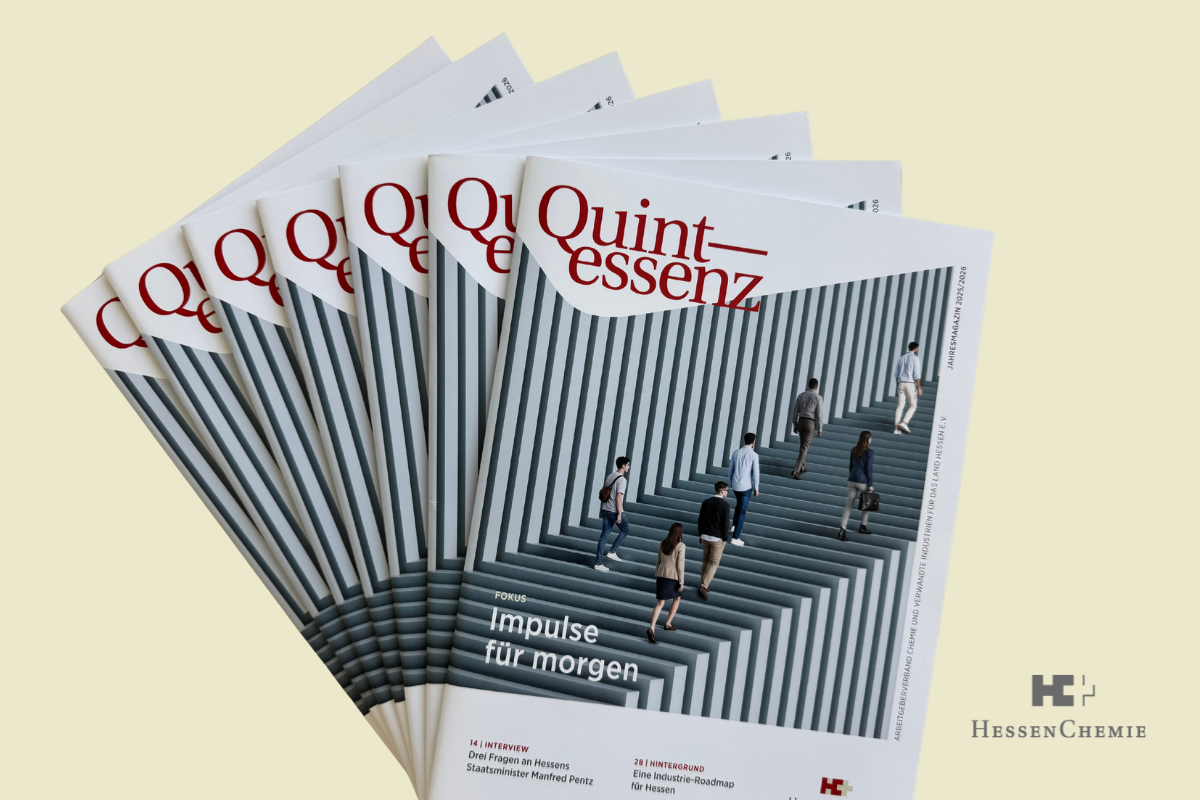
Dr Fabiana Fantinel was interviewed recently for an article in the German magazine Quintessenz, employers’ association HessenChemie’s annual magazine . Each issue focuses on a specific theme and examines issues relevant to economic development, industrial practice, and the transformation of the industry. In addition to opinion pieces and background articles, the magazine features examples of the association’s work, reports on events and projects, and insights from member companies. It highlights the issues shaping the chemical, pharmaceutical, and plastics processing industries in Hesse.
You can read the article (in German) HERE.
English translation:
CO₂ as a Resource
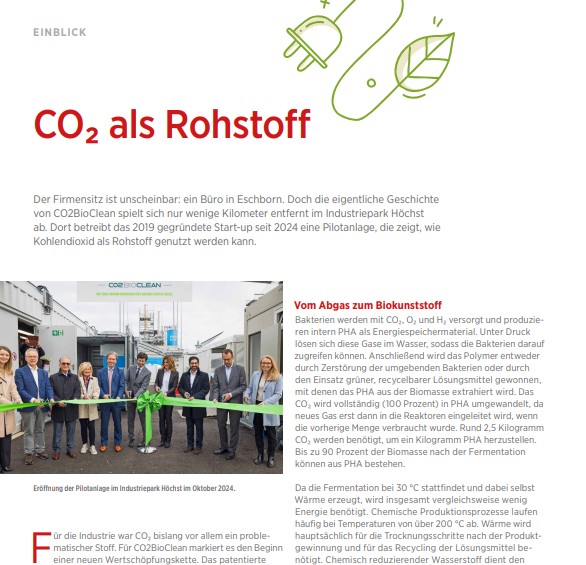
The company’s headquarters are modest: an office in Eschborn. But the real story of CO2BioClean unfolds just a few kilometers away – at Industriepark Höchst. There, the start-up, founded in 2019, has been operating a pilot plant since 2024 that demonstrates how carbon dioxide can be used as a resource.
For industry, CO₂ has so far primarily been a problematic substance. For CO2BioClean, it marks the beginning of a new value chain. The patented fermentation process uses industrial CO2 emissions to produce biodegradable and compostable polymers which can then be used in the production (for example) of bioplastics and textiles.. CO2 is captured at source from industrial facilities and transformed through fermentation into fully biodegradable PolyHydroxyAlkanoates (PHA). “My motivation came from a combination of scientific curiosity and a growing sense of urgency around climate change,” says co-founder Dr. Fabiana Fantinel. “During my academic work, I was deeply involved in biochemical processes and realized that biology offers powerful, underutilized tools for carbon capture.“
From Emissions to Bioplastics
Bacteria are fed with CO2, O2, and H2 and produce PHA internally as an energy storage material. Under pressure, these gases dissolve in water so the bacteria can access them. In the end, the polymer is obtained either by destroying the surrounding bacteria or by utilizing green recyclable solvents to extract the PHA from the biomass. The CO2 is converted completely (100%) into PHA, because new gas is only added into the reactors once the previous supply has been consumed. Around 2.5 kg of CO2 are used to produce 1 kg of PHA. Up to 90% of the biomass after fermentation can consist of PHA. Because the fermentation takes place at 30 °C and also generates heat itself, comparatively little energy is required overall. Chemical production often occurs at temperatures above 200 °C. Heat is mainly needed during the drying steps after the product is obtained and for recycling the solvents. Chemically reducing hydrogen is the source of energy for the bacteria and therefore a critical part of the fermentation. At the same time, expanding infrastructure and new modular methods of H2 production are helping to meet demand while supporting sustainability without scale issues. The remaining bacterial biomass is the only side stream. It could potentially be utilized as feedstock for future fermentations or as feed for farm animals, as it is very rich in protein. The bacteria can even utilize atmospheric levels of CO2, meaning no concentrated CO2 stream is required, except to increase yields. In addition, bacteria are much more resistant to impurities than chemical catalysts.
Scaling the Technology
The decisive test takes place at Industriepark Höchst. Here, the process is no longer tested in the lab but in continuous operation under real industrial conditions. “Operating at Industriepark Höchst has been invaluable,” says Dr. Fantinel. “We’ve learned how our system behaves under continuous industrial conditions, including variability in gas streams and operational constraints.” At the beginning of 2026, CO2BioClean sees itself in a transition phase: the technology has been validated, and the focus is now on scaling. At the same time, the company is working closely with partners from industry and research. According to Dr. Fantinel, “without this ecosystem, progress at our speed would not be possible.” The company is led by a founding team with complementary expertise. While Dr. Fantinel is responsible for strategy and development, co-founder Alessandro Carfagnini contributes his expertise in material development. “Bridging production and application is a key strength of CO2BioClean,” says Dr. Fabiana Fantinel. The range of applications for PHA is broad: from packaging and textile materials to biodegradable tree shelters. The greatest potential lies in sectors with unavoidable CO₂ emissions, such as chemicals, steel, and waste management.
The next step is industrial implementation. CO2BioClean is currently planning its first commercial-scale plant. “A real breakthrough, for me, is when our technology becomes a viable, widely adopted solution—not just a promising innovation,” says Dr. Fabiana Fantinel. For now, CO2BioClean is still a start-up. But in Höchst, it is already becoming clear how CO₂ can be turned into a resource – and how an idea can become an industrial process.